Google Reviews ⭐⭐⭐⭐⭐

- Cause #1: Circuit Overload
- Cause #2: Short Circuit
- Cause #3: Earth Fault
- Cause #4: Faulty or Ageing Circuit Breaker
- Cause #5: Arc Fault
- Cause #6: Loose or Damaged Wiring Connections
- Cause #7: Faulty Appliance
If your circuit breaker keeps tripping, it is not a random annoyance — it is a protection device doing exactly what it was designed to do, and the underlying cause needs to be identified before you reset it again. SafeWork NSW is clear that electrical faults should be investigated by a licensed electrician rather than by homeowners probing wiring themselves. This guide covers the seven most common reasons a breaker trips, what you can safely check, and when to call a professional — with links to our full circuit breaker fault guide for deeper reading on each issue.
Seven Reasons Your Circuit Breaker Keeps Tripping
Understanding why your breaker trips is the first step toward fixing it safely. Some causes are straightforward; others point to a fire or shock risk that needs immediate professional attention.
Cause #1: Circuit Overload
Every circuit has a current rating — typically 20 A for power outlet circuits and 10 A for lighting circuits. When the combined load of appliances running at the same time exceeds that rating, the MCB (miniature circuit breaker) cuts power to prevent the wiring from overheating and potentially starting a fire.
Common culprits include daisy-chained power boards and high-draw appliances — think portable heaters, air conditioners, or electric kettles — sharing a single circuit.
What you can safely do: Unplug all appliances on that circuit, then reset the breaker once. If it holds, spread your appliances across different circuits rather than loading one circuit with multiple high-draw devices. If the breaker trips again with minimal load connected, there is a deeper fault — call a licensed electrician.
Cause #2: Short Circuit
A short circuit happens when the active (live) conductor contacts the neutral conductor, producing a sudden, uncontrolled current surge that trips the MCB almost instantly. It can produce sparks, a burning smell, or a discoloured power point.
The most common causes are damaged cord insulation and faulty appliances. If you have recently plugged in a new device and the breaker tripped straight away, that appliance is worth suspecting. Short circuits can also point to power surge or damage that has weakened insulation elsewhere on the circuit.
What you can safely do: Look for visible cord damage or a recently added appliance. Do not handle wiring. A short circuit is a fire risk — always call a licensed electrician to diagnose and repair it.
Cause #3: Earth Fault
An earth fault occurs when the active conductor contacts the earth wire or an earthed surface. This is especially common in wet areas — kitchens, bathrooms, and laundries — where insulation degrades over time from moisture exposure.
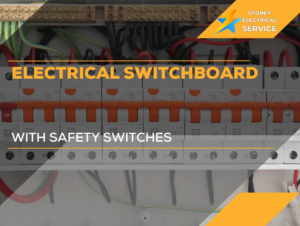
Your switchboard should have RCDs (residual current devices, also called safety switches) installed alongside standard MCBs. Safety switches are specifically designed to detect earth faults and respond far faster than a breaker alone. If it is your safety switch tripping rather than an MCB, our guide on safety switch keeps tripping explains the distinction. You can also read more about how safety switches work and why they are essential in every modern switchboard.
What you can safely do: Look for signs of recent water ingress near the affected outlet. Do not attempt to open the outlet or touch any wiring. Earth faults carry a serious shock risk — call a licensed electrician.
Cause #4: Faulty or Ageing Circuit Breaker
MCBs are not designed to last indefinitely. In older Sydney homes, breakers that are 30 to 40 years old can have thermal elements that have degraded and now trip at currents well below their rated capacity. Signs include tripping with minimal load, a breaker that will not reset, or a lever that feels loose or spongy.
A major fault event — such as a short circuit — can also push a breaker to the end of its operational life, leaving it unable to hold reliably.
What you can safely do: Wait 30 seconds, then reset the breaker once. If it trips immediately or will not reset at all, leave it in the off position. Continuing to force a failed breaker is dangerous. A licensed electrician can replace the breaker and assess whether the switchboard needs a switchboard upgrade — older panels often lack the safety features required by modern Australian Standards.
Cause #5: Arc Fault
An arc fault occurs when electricity jumps a gap in damaged or degraded wiring, generating localised heat that can ignite nearby materials. Unlike an overload, an arc fault does not always draw enough current to trip a standard MCB promptly — which makes it one of the less visible but more serious fire risks in older homes.
Arc faults are more common where wiring insulation has aged, or where nails and screws have been driven through walls and inadvertently pierced cables. Scorch marks around power points, a persistent burning smell, or intermittent power loss on a circuit are all warning signs.
What you can safely do: Look for scorch marks or smell for burning. Do not investigate inside walls or outlets. Treat this as an emergency — our emergency electricians respond across Sydney in 30–90 minutes. Call 0433 462 902.
Cause #6: Loose or Damaged Wiring Connections
A loose terminal connection inside a switchboard or at an outlet creates resistance, and resistance generates heat. That heat can cause intermittent thermal tripping even when the overall circuit load is well within normal limits.
This issue is more common in older homes and in properties where unlicensed electrical work has been carried out. Aluminium wiring — common in Australian homes built during the 1960s and 70s — expands and contracts differently to copper, which causes connections to work loose over time.
What you can safely do: Nothing. Do not open your switchboard, and do not attempt to tighten connections yourself. Call a licensed electrician.
Cause #7: Faulty Appliance
A single malfunctioning appliance — an ageing fridge compressor, a failing portable heater element, or a deteriorating oven — can draw excessive current and trip the circuit without any underlying wiring fault at all.
Real-life example: A homeowner noticed their kitchen circuit tripping every few days with no obvious pattern. After unplugging each appliance in turn and resetting the breaker, the fault pointed to an older microwave drawing far above its rated current — taking it out of service stopped the tripping immediately.
What you can safely do: Unplug every appliance on the affected circuit, reset the breaker, then reconnect devices one at a time. If the breaker trips when you reconnect a specific appliance, take it out of service and have it inspected or replaced. If the breaker trips with everything unplugged, the fault is in the wiring itself — call a licensed electrician.
FAQs
When your circuit breaker keeps tripping, is it safe to reset it repeatedly?
Resetting once is reasonable — it is a standard step to check whether the trip was a momentary overload. Resetting repeatedly without identifying the cause is not safe. A circuit breaker that keeps tripping is signalling a fault; ignoring it and forcing the breaker back on risks overheating, fire, or electric shock.
What is the difference between a circuit breaker and a safety switch?
A circuit breaker (MCB) protects the wiring by cutting power when current exceeds the rated load. A safety switch (RCD) protects people by detecting tiny leakage currents to earth and cutting power within milliseconds — fast enough to prevent a fatal shock. They serve different purposes and work best together. If your safety switch is the device tripping, our guide on safety switch keeps tripping covers the likely causes.
Can I fix a tripping circuit breaker myself?
You can safely unplug appliances, spread load across circuits, and reset a breaker once. Beyond that, diagnosing and repairing electrical faults requires a licensed electrician. Opening a switchboard, touching wiring, or replacing a breaker without the correct licence is illegal in NSW and genuinely dangerous.
Why does my circuit breaker trip only at certain times of day?
Time-of-day tripping usually points to circuit overload — the pattern follows when high-draw appliances run simultaneously, such as the oven, air conditioner, and dishwasher all running during dinner preparation. It can also indicate a thermal fault in an ageing breaker whose trip threshold drops as it warms up. Either way, a licensed electrician can confirm the cause with a load test.
How do I know if I need a switchboard upgrade?
Signs include a switchboard with ceramic fuses rather than modern MCBs, no safety switches, breakers that trip repeatedly, or a board that is more than 25–30 years old. A licensed electrician can assess whether a switchboard upgrade is required to bring your home up to current safety standards.
Does a tripping circuit breaker mean there is a fire risk?
Not always — a tripped breaker from a straightforward overload carries low immediate fire risk once the load is reduced. However, causes such as short circuits, arc faults, and loose connections all involve heat generation that can ignite building materials, sometimes without any visible warning. If you smell burning, see scorch marks, or cannot identify a clear cause, treat it as urgent and call a licensed electrician.
How long does a circuit breaker fault diagnosis take?
Simple overload checks are quick; tracking an intermittent arc fault or inspecting aluminium wiring connections takes longer. We give you an upfront quote before any work begins, with no after-hours surcharge.
Keeping Your Circuits Safe with Sydney Electrical Service
At Sydney Electrical Service, we are rated 4.8/5 from 100+ Google reviews and back every job with a 12-month workmanship guarantee — our Level 2 electricians are Ausgrid-authorised and available 24/7 with no after-hours surcharge.
Contact Us Today — 0433 462 902 If Your Circuit Breaker Keeps Tripping
Call us any time of day or night to speak with a licensed electrician about your tripping circuit breaker, or send your online enquiry and we’ll call you back.